Agents That Own Their Inference: Building Production AI Agents on Dedicated GPUs
Conference Context
- Date/time: 2026-06-29 · 9:00am-11:00am
- Room: Track 7
- Speaker(s): Du'an Lightfoot
- Session type/status: sponsor · confirmed
- Track: track TBD
- Session type: sponsor
- Status: confirmed
Session Description
Every production agent today is renting its intelligence. You're paying per token, sending your customer's data to someone else's servers, and hoping the provider doesn't rate-limit you during your launch. For most teams, that's fine. But for a growing number of teams in regulated industries, with high-volume products, latency-sensitive workloads, or rising token bills, it's starting to look like a liability. In this 120-minute hands-on workshop you'll get a dedicated GPU and build an agent that runs on infrastructure you control. You'll stand up vLLM, point your agent at it, and drive concurrent load through the stack until you can see batching, KV cache pressure, and throughput limits in the metrics. Then you'll optimize the deployment to improve throughput while keeping per-request latency in line. The focus isn't agent frameworks. It's the inference layer underneath them. You'll leave with working code and a real understanding of continuous batching under real concurrency, KV cache tradeoffs, vLLM's metrics, and the bottlenecks that only show up when you operate the inference server yourself.
Media Evidence
Building Agents with Amazon Nova Act and MCP - Du'An Lightfoot, Amazon (Full Workshop) (speaker-match related prior/adjacent AI Engineer video; captions: English auto-captions).
- youtube wFTVEDYVJT0 transcript — full cached transcript markdown for the related YouTube source.
- Source video:
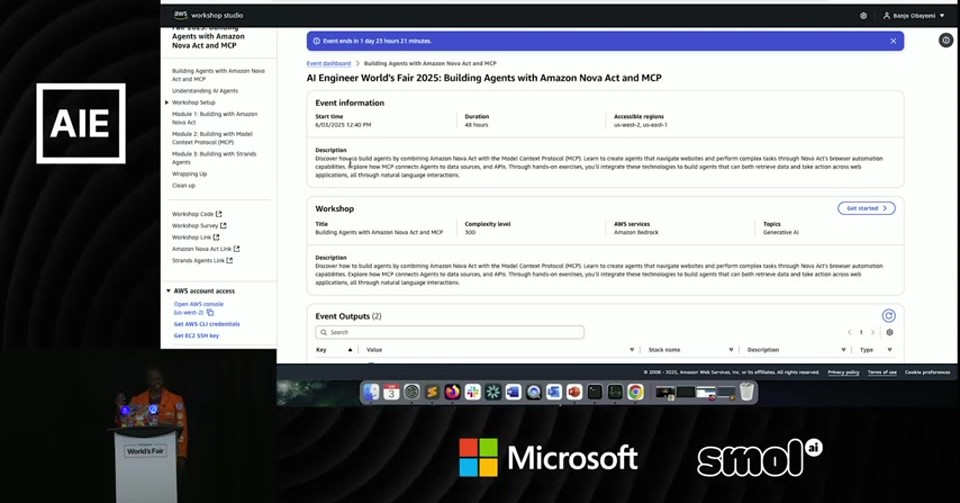
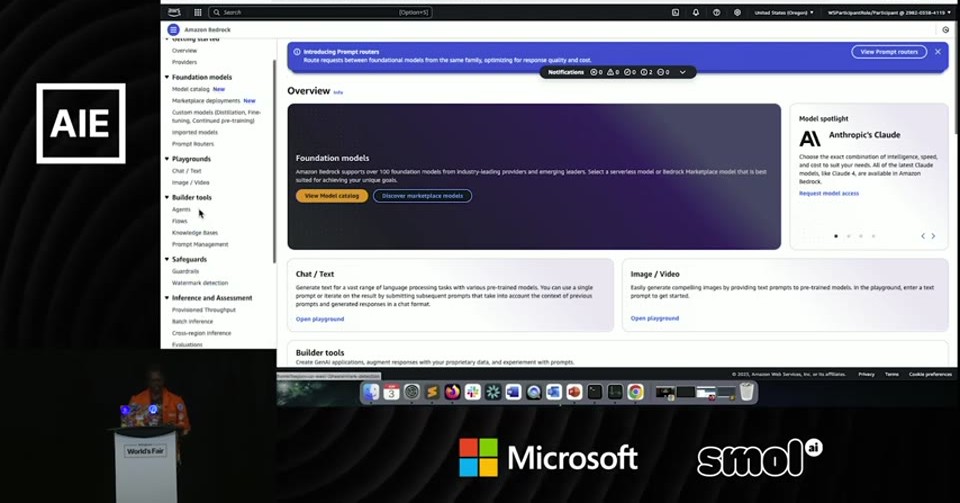
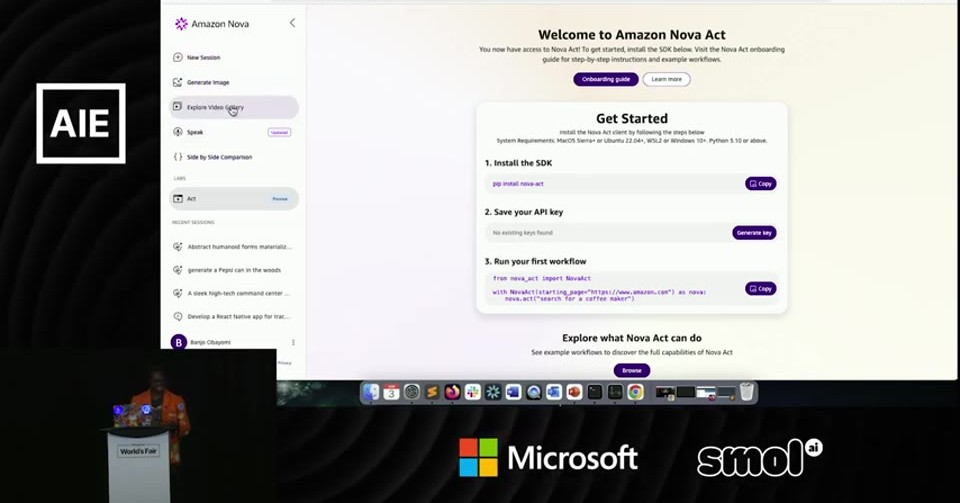
youtube-wFTVEDYVJT0 - Slide deck: Dense Slides: Building Agents with Amazon Nova Act and MCP - Du'An Lightfoot, Amazon (Full Workshop) — 4 visible slide image(s); 4 HTML recreation(s).
- Additional slide evidence: Slides: Building Agents with Amazon Nova Act and MCP - Du'An Lightfoot, Amazon (Full Workshop), Reconstructed Slides: Building Agents with Amazon Nova Act and MCP - Du'An Lightfoot, Amazon (Full Workshop)
- Slide-derived themes for
youtube-wFTVEDYVJT0: safeguards, chat, text, image, welcome, amazon, nova.
Evidence Graph
This evidence graph is generated from currently linked source material: official schedule text, related video pages, cached transcripts, visible slide text, dense/reconstructed slide pages, and AI slide-classification audits.
Media Signals
youtube-wFTVEDYVJT0— 13,586 transcript words; 2 slide-derived text signals- Transcript signals for
youtube-wFTVEDYVJT0: nova, amazon, code, server, browser, able, open, click. - Slide-derived themes for
youtube-wFTVEDYVJT0: safeguards, chat, text, image, welcome, amazon, nova. - Evidence links for
youtube-wFTVEDYVJT0: youtube wFTVEDYVJT0, youtube wFTVEDYVJT0 transcript, youtube wFTVEDYVJT0 slides, youtube wFTVEDYVJT0 dense slides, youtube wFTVEDYVJT0 reconstructed slides
Agent Reading Notes
Use these signals to refine the synopsis, topic links, people/company context, and method notes. If a source is a related external video rather than an exact official recording, keep it framed as supporting evidence.
Summary
Du'an Lightfoot's World's Fair workshop is a production-inference lab for agent teams that want the model endpoint to become infrastructure they own rather than an external token API they rent. The official session description names the operational pressure points directly: customer data leaving the team's boundary, provider rate limits during launches, high-volume products, latency-sensitive workloads, regulated-industry constraints, and token bills that turn inference into a scaling risk. The hands-on shape is concrete: participants get a dedicated GPU, stand up vLLM, connect an agent to that endpoint, and then push concurrent traffic through the system until batching, KV-cache pressure, throughput limits, and latency tradeoffs become visible in metrics.
The connected Du'an Lightfoot people page makes the production framing sharper: Lightfoot is described as a Senior AI Engineer at Akamai Technologies, where AI work intersects with network engineering and infrastructure. That background matters because this session is not pitched as an agent-framework tutorial. It is about the layer underneath the agent: the GPU-backed serving stack, the scheduler, the cache, the observability surface, and the failure modes that only appear when multiple requests compete for the same inference server. In this page's evidence model, the official schedule supplies the confirmed World's Fair topic, while the connected YouTube, transcript, and slide pages supply adjacent public context for Lightfoot's agent-building vocabulary.
The related AI Engineer video, "Building Agents with Amazon Nova Act and MCP," should be treated as supporting context rather than a confirmed recording of this exact session. Its extracted, dense, and reconstructed slide pages point to application-level concepts such as tools, actions, environments, memory, autonomous systems, model-driven execution, Amazon Nova, and MCP. Read alongside those pages, this World's Fair workshop looks like the infrastructure counterpart to that agentic-systems material. A team can use Nova Act, MCP, tools, memory, and environment interaction to design the agent loop, but this session asks what happens when the agent's intelligence depends on a self-operated model server under real load.
The key synthesis is that "owning inference" expands the reliability boundary of an agent product. Once the team runs vLLM on a dedicated GPU, product behavior is shaped by continuous batching efficiency, KV-cache capacity, request concurrency, per-request latency targets, GPU utilization, and the quality of metrics available during tuning. The workshop's likely value is not just that attendees leave with working code; it is that they see the hidden coupling between agent design and inference operations. Tool-calling agents, autonomous workflows, and MCP-connected systems all become more operationally serious when their model-serving endpoint is a component the team must capacity-plan, observe, and optimize itself.
Transcript Status
Related video transcript availability: English auto-captions. Treat this as supporting context, not a recording of this exact scheduled session unless later confirmed. Cached at raw/sources/youtube-transcripts/wFTVEDYVJT0.txt (13,586 words).
People
Supporting Slides
- youtube wFTVEDYVJT0 slides — extracted from the related public AI Engineer video.
Slide Evidence
- Slide-only cropped deck: youtube wFTVEDYVJT0 dense slides (6 viable slide images).
- Related slide/OCR pages:
- youtube wFTVEDYVJT0 dense slides
- youtube wFTVEDYVJT0 reconstructed slides
- youtube wFTVEDYVJT0 slides
- Slide-derived terms:
tools,microsoft,agentic,model,actions,https,world,amazon,execute,system,look,tere,nova,memory,environment,brain,autonomous,systems
Synthesis
Synthesized Breakdown
Building agents with Amazon Nova ACT and MCP. I'm excited today because we're going to build intelligent autonomous AI systems that can help you build, scale, and improve your applications and business. My name is Dewan Lightoot and I'm joined by swap. Swap.
Speaker And Company Context
- No speaker profile is attached in the official schedule data.
Topics Covered
Derived Links And Source Material
- youtube wFTVEDYVJT0 transcript — transcript markdown; source cache
raw/sources/youtube-transcripts/wFTVEDYVJT0.txt(13,586 words). - youtube wFTVEDYVJT0 — related YouTube source page.
- youtube wFTVEDYVJT0 slides — slide evidence.
- youtube wFTVEDYVJT0 reconstructed slides — slide evidence.
- youtube wFTVEDYVJT0 dense slides — slide evidence.
Novel Concepts / Clever Methods
- No highlighted novel concept has been detected yet.
Evidence Boundary
This synthesis uses the official schedule plus cached video transcripts. Official AI Engineer World's Fair San Francisco 2026 livestreams and cut videos are primary event video sources for transcript/slide evidence; external, historical, or speaker-matched videos remain supporting context unless manually verified as exact official event recordings.