Building self-learning loops for your agent
Conference Context
- Date/time: 2026-06-29 · 11:05am-12:05pm
- Track/room: Posttraining & Midtraining · Track 1
- Speaker(s): Fuad Ali
- Session type/status: sponsor · confirmed
- Track: Posttraining & Midtraining
- Room: Track 1
- Session type: sponsor
- Status: confirmed
Session Description
Building an AI demo is easy. Knowing whether it actually works — and keeping it working in production — is the hard part. Most teams ship agents on vibes: they try a few prompts, the output looks good, and they push to production with no real way to measure quality or catch regressions. This hands-on workshop walks through the full lifecycle of shipping a real AI agent, using a working financial-analyst agent built on the Claude Agent SDK as the running example. You'll instrument it with tracing, do structured error analysis on its actual outputs, and build a layered evaluation suite — from cheap deterministic code checks to LLM-as-a-judge evaluators with custom rubrics. We'll cover the parts most tutorials skip: why agents fail in ways single LLM calls don't, the eval anti-patterns that quietly mislead you, and how to know whether you can even trust your judge (meta-evaluation). Finally, we'll close the loop: turning eval results into datasets and experiments, running evals online against production traffic, wiring them to monitors and alerts, and feeding failure explanations back to a coding agent to actually fix the underlying problems. You'll leave with a runnable notebook and a repeatable, evaluation-driven workflow you can apply to your own agents the next day.
Media Evidence
Build a Prompt Learning Loop - SallyAnn DeLucia & Fuad Ali, Arize (speaker-match related prior/adjacent AI Engineer video; captions: English auto-captions).
- Source video:
youtube-SbcQYbrvAfI - Slide deck: Dense Slides: Build a Prompt Learning Loop - SallyAnn DeLucia & Fuad Ali, Arize — 32 visible slide image(s); 32 HTML recreation(s).
- Additional slide evidence: Slides: Build a Prompt Learning Loop - SallyAnn DeLucia & Fuad Ali, Arize, Reconstructed Slides: Build a Prompt Learning Loop - SallyAnn DeLucia & Fuad Ali, Arize
- Slide-derived themes for
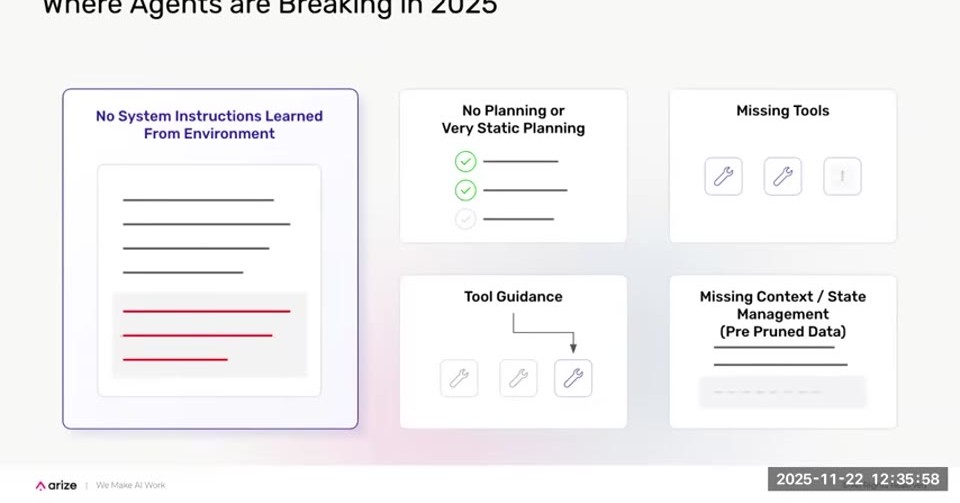
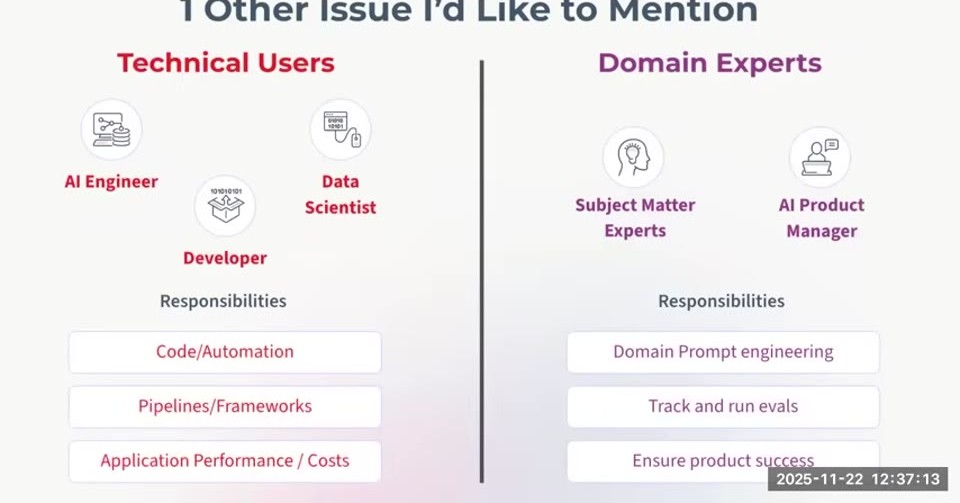
youtube-SbcQYbrvAfI: planning, missing, data, domain, breaking, system, instructions, learned.
Evidence Graph
This evidence graph is generated from currently linked source material: official schedule text, related video pages, cached transcripts, visible slide text, dense/reconstructed slide pages, and AI slide-classification audits.
Media Signals
youtube-SbcQYbrvAfI— 7 slide-derived text signals- Slide-derived themes for
youtube-SbcQYbrvAfI: planning, missing, data, domain, breaking, system, instructions, learned. - Evidence links for
youtube-SbcQYbrvAfI: youtube SbcQYbrvAfI, youtube SbcQYbrvAfI slides, youtube SbcQYbrvAfI dense slides, youtube SbcQYbrvAfI reconstructed slides
Agent Reading Notes
Use these signals to refine the synopsis, topic links, people/company context, and method notes. If a source is a related external video rather than an exact official recording, keep it framed as supporting evidence.
Transcript Status
Related video transcript availability: English auto-captions. Treat this as supporting context, not a recording of this exact scheduled session unless later confirmed. Not fetched yet.
People
Supporting Slides
- youtube SbcQYbrvAfI slides — extracted from the related public AI Engineer video.
Slide Evidence
- Slide-only cropped deck: youtube SbcQYbrvAfI dense slides (32 viable slide images).
- Related slide/OCR pages:
- youtube SbcQYbrvAfI dense slides
- youtube SbcQYbrvAfI reconstructed slides
- youtube SbcQYbrvAfI slides
- Slide-derived terms:
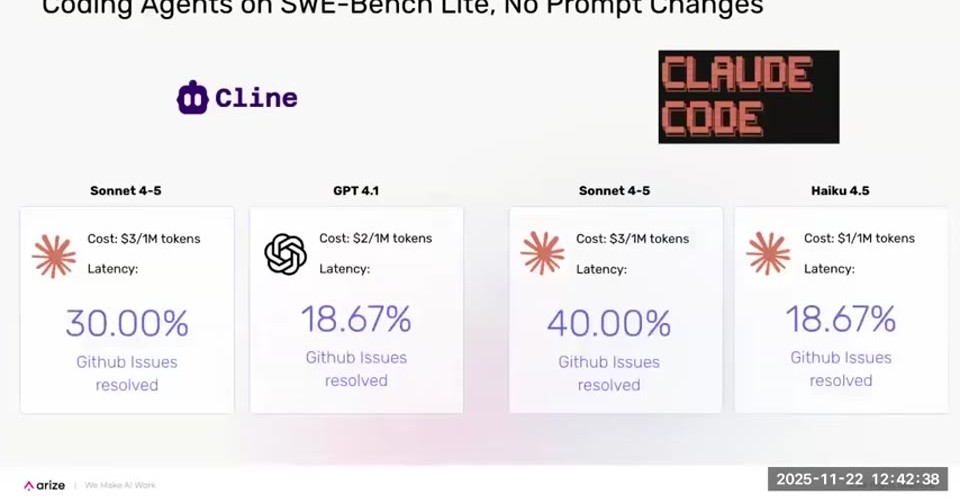
prompt,learning,system,rules,coding,gepa,score,changes,cost,claude,test,mone,planning,missing,aarize,evals,function,exam
Synthesis
Synthesized Breakdown
Building self-learning loops for your agent ## Conference Context - Date/time: 2026-06-29 · 11:05am-12:05pm - Track/room: Posttraining & Midtraining · Track 1 - Speaker(s): Fuad Ali - Session type/status: sponsor · confirmed - Track: Posttraining & Midtraining - Room: Track 1 - Session type: sponsor - Status: confirmed ## Session Description Building an AI demo is easy. Knowing whether it actually works — and keeping it working in production — is the hard part. Most teams ship agents on vibes: they try a few prompts, the output looks good, and they push to production with no real way to measure quality or catch regressions. This hands-on workshop walks through the full lifecycle of shipping a real AI agent, using a working financial-analyst agent built on the Claude Agent SDK as the running example.
Speaker And Company Context
Topics Covered
Derived Links And Source Material
- youtube SbcQYbrvAfI — related YouTube source page.
- youtube SbcQYbrvAfI slides — slide evidence.
- youtube SbcQYbrvAfI reconstructed slides — slide evidence.
- youtube SbcQYbrvAfI dense slides — slide evidence.
Novel Concepts / Clever Methods
- No highlighted novel concept has been detected yet.
Evidence Boundary
This synthesis is based on the official schedule and linked source pages. It should be revisited when exact session recordings or transcript-backed secondary sources are available.