The Search Engine for the Agentic Web
Conference Context
- Date/time: 2026-06-29 · 11:40am-12:00pm
- Track/room: Search & Retrieval · Track 3
- Speaker(s): Will Bryk
- Session type/status: session · confirmed
- Track: Search & Retrieval
- Room: Track 3
- Session type: session
- Status: confirmed
Session Description
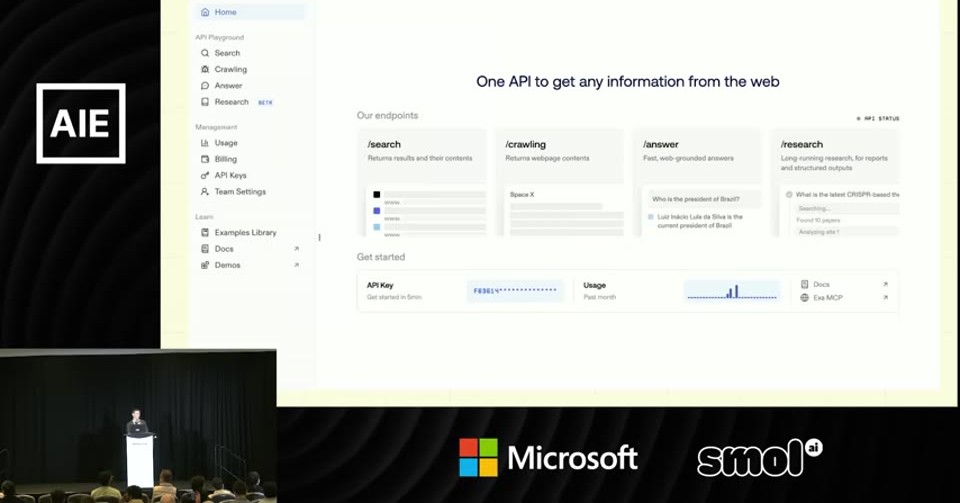
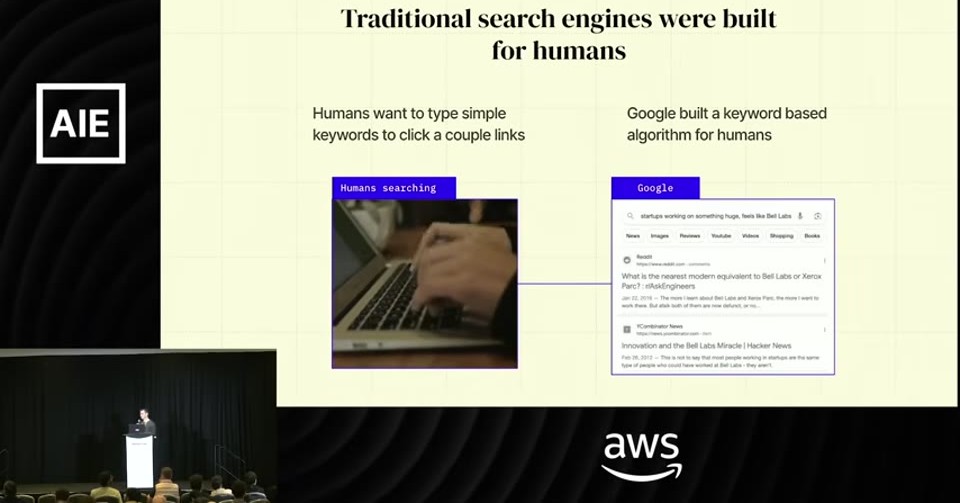
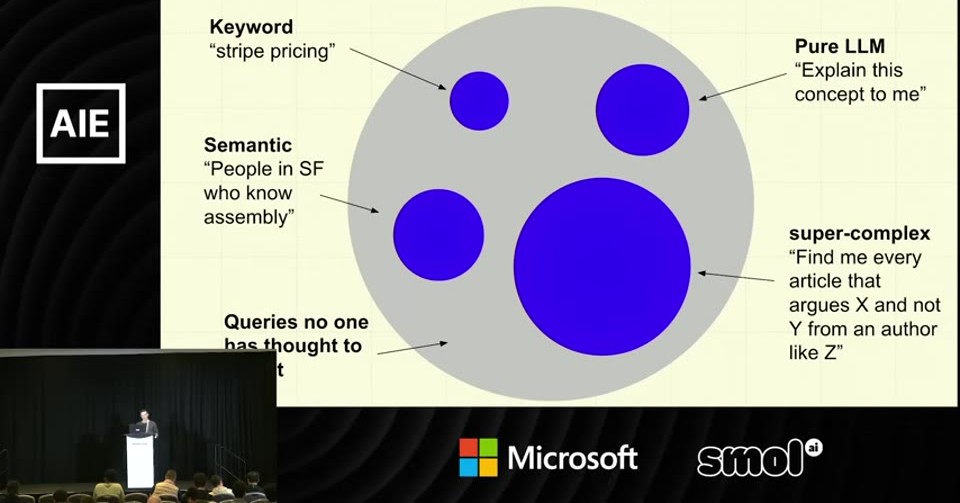
Every search API claiming to be "built for AI" is actually Google with a wrapper. That's a problem, because AI agents don't search like humans. A human waits 1 second for a result. An agent making 50 sequential searches at 1 second each creates a 50-second lag. That kills the product. And latency is just one dimension: agents need semantic precision, structured outputs, and a range that spans sub-200ms real-time retrieval all the way to multi-step deep research. No human-facing search engine was ever designed to do that. Will Bryk, CEO of Exa, shares what he learned building a search engine from scratch for AI. He'll cover the architectural decisions behind Exa's latency spectrum, what real usage patterns look like across companies like Cursor, Notion, HubSpot, and Lovable, and why the benchmarks the field relies on today are dangerously inadequate for evaluating agentic search. The bigger argument: search is becoming the most critical primitive in AI infrastructure, and almost no one is building it right.
Media Evidence
Building a Smarter AI Agent with Neural RAG - Will Bryk, Exa.ai (speaker-match related prior/adjacent AI Engineer video; captions: English auto-captions).
- Source video:
youtube-xnXqpUW_Kp8 - Slide deck: Dense Slides: Building a Smarter AI Agent with Neural RAG - Will Bryk, Exa.ai — 4 visible slide image(s); 4 HTML recreation(s).
- Additional slide evidence: Slides: Building a Smarter AI Agent with Neural RAG - Will Bryk, Exa.ai, Reconstructed Slides: Building a Smarter AI Agent with Neural RAG - Will Bryk, Exa.ai
- Slide-derived themes for
youtube-xnXqpUW_Kp8: humans, built, information, traditional, search, engines, type, simple.
Evidence Graph
This evidence graph is generated from currently linked source material: official schedule text, related video pages, cached transcripts, visible slide text, dense/reconstructed slide pages, and AI slide-classification audits.
Media Signals
youtube-xnXqpUW_Kp8— 5 slide-derived text signals- Slide-derived themes for
youtube-xnXqpUW_Kp8: humans, built, information, traditional, search, engines, type, simple. - Evidence links for
youtube-xnXqpUW_Kp8: youtube xnXqpUW_Kp8, youtube xnXqpUW_Kp8 slides, youtube xnXqpUW_Kp8 dense slides, youtube xnXqpUW_Kp8 reconstructed slides
Agent Reading Notes
Use these signals to refine the synopsis, topic links, people/company context, and method notes. If a source is a related external video rather than an exact official recording, keep it framed as supporting evidence.
Summary
Will Bryk's World's Fair session treats search as a core runtime dependency for agentic systems, not as a human-facing results page with an API wrapped around it. The official session description is explicit about the failure mode: an agent that performs dozens of sequential searches cannot tolerate one-second human-search latency multiplied across a workflow, and it also needs semantic precision, structured outputs, and retrieval modes that range from sub-200ms lookups to deeper multi-step research. The connected people page grounds the speaker context: Bryk is the co-founder and CEO of Exa, the AI-native search company represented in the World's Fair 2026 roster, so the talk sits at the intersection of search architecture, agent infrastructure, and product usage patterns at companies named in the schedule such as Cursor, Notion, HubSpot, and Lovable.
The related AI Engineer YouTube video and slide pages should be treated as supporting context rather than a confirmed recording of this exact session. They still sharpen the likely technical center of gravity. The linked Exa material is titled around Neural RAG and shows agent-oriented search examples, including Python/agent code, console/debug output, GitHub-agent references, and slide-derived terms such as agent.py, github_agent.py, search, output, debug, console, terminal, and information. That evidence points to search as a programmable component inside agent loops: something an agent calls, inspects, debugs, and chains into downstream reasoning, rather than a static list of blue links. The reconstructed and dense slide decks add a useful caution layer too: some details are OCR- or slide-derived, so they are best used to explain the adjacent Exa/Neural RAG context while keeping the official schedule claims separate from inferred synthesis.
Taken together, the page frames agentic search as an evaluation and systems-design problem. The scheduled talk argues that today's search benchmarks can miss what matters when software, not a person, consumes the results: latency budgets across repeated calls, precision under semantic intent, result structure suitable for tool use, and reliability across short retrieval and longer research workflows. The connected transcript map reinforces that no exact normalized title match was found for a session recording, so the strongest current summary is evidence-layered: official schedule for the World's Fair claim, Will Bryk/Exa pages for speaker and company context, and the related Neural RAG slides/video for concrete examples of how Exa presents search inside AI-agent workflows.
Transcript Status
Related video transcript availability: English auto-captions. Treat this as supporting context, not a recording of this exact scheduled session unless later confirmed. Not fetched yet.
People
Supporting Slides
- youtube xnXqpUW_Kp8 slides — extracted from the related public AI Engineer video.
Slide Evidence
- Slide-only cropped deck: youtube xnXqpUW_Kp8 dense slides (4 viable slide images).
- Related slide/OCR pages:
- youtube xnXqpUW_Kp8 dense slides
- youtube xnXqpUW_Kp8 reconstructed slides
- youtube xnXqpUW_Kp8 slides
- Slide-derived terms:
https,microsoft,agent.py,python,smol,search,output,info,none,explorer,oerv,github_agent.py,problems,debug,console,terminal,print,information
Synthesis
Synthesized Breakdown
The Search Engine for the Agentic Web ## Conference Context - Date/time: 2026-06-29 · 11:40am-12:00pm - Track/room: Search & Retrieval · Track 3 - Speaker(s): Will Bryk - Session type/status: session · confirmed - Track: Search & Retrieval - Room: Track 3 - Session type: session - Status: confirmed ## Session Description Every search API claiming to be "built for AI" is actually Google with a wrapper. That's a problem, because AI agents don't search like humans. A human waits 1 second for a result. An agent making 50 sequential searches at 1 second each creates a 50-second lag.
Speaker And Company Context
- No speaker profile is attached in the official schedule data.
Topics Covered
Derived Links And Source Material
- youtube xnXqpUW_Kp8 — related YouTube source page.
- youtube xnXqpUW_Kp8 slides — slide evidence.
- youtube xnXqpUW_Kp8 reconstructed slides — slide evidence.
- youtube xnXqpUW_Kp8 dense slides — slide evidence.
Novel Concepts / Clever Methods
- No highlighted novel concept has been detected yet.
Evidence Boundary
This synthesis is based on the official schedule and linked source pages. It should be revisited when exact session recordings or transcript-backed secondary sources are available.