It’s Tokens All The Way Down: How RLMs are Different
Conference Context
- Date/time: 2026-06-30 · 11:10am-11:30am
- Track/room: Context Engineering · Track 8
- Speaker(s): Kevin Madura
- Session type/status: session · confirmed
- Track: Context Engineering
- Room: Track 8
- Session type: session
- Status: confirmed
Session Description
Recursive Language Models represent an intuitive but distinctively important approach to how LLMs handle context. The practical implications are bigger than they first appear. Tasks that would traditionally require careful prompt engineering, custom agent scaffolding, or multi-step orchestration collapse into surprisingly simple, composable programs. In this talk, we’ll cover what makes an RLM distinct from a coding agent, explore where the abstraction shines and where it breaks down, and walk through concrete use cases that are informed by real-world situations at scale. We’ll see side-by-side comparisons to understand trade-offs in complexity, performance, time, and token usage.
Media Evidence
DSPy: The End of Prompt Engineering - Kevin Madura, AlixPartners (speaker-match related prior/adjacent AI Engineer video; captions: English auto-captions).
- Source video:
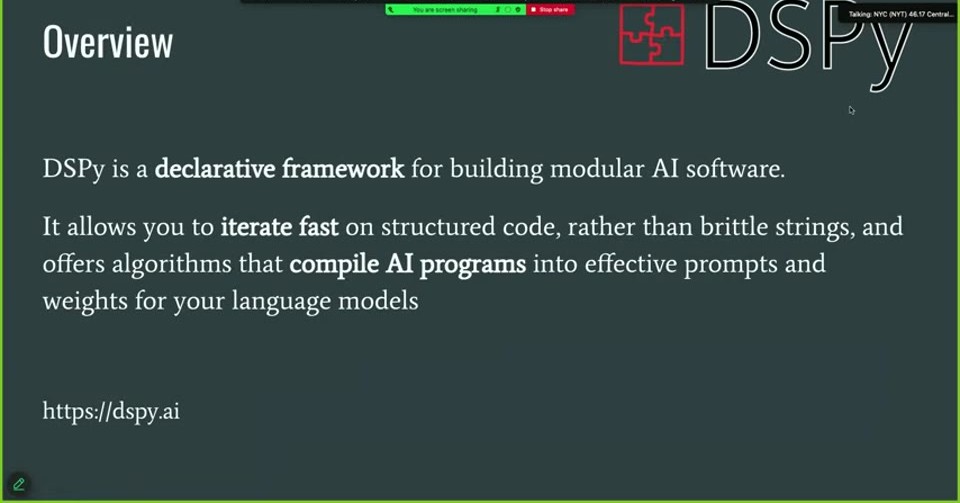
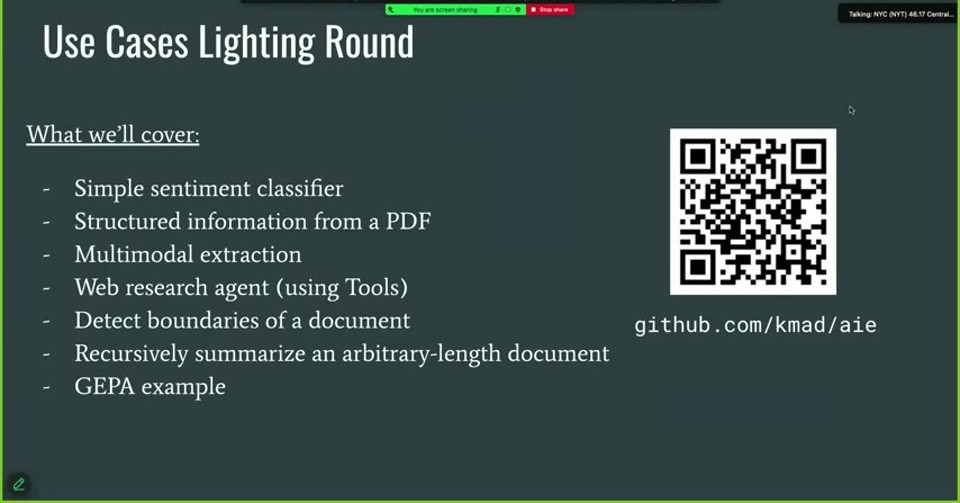
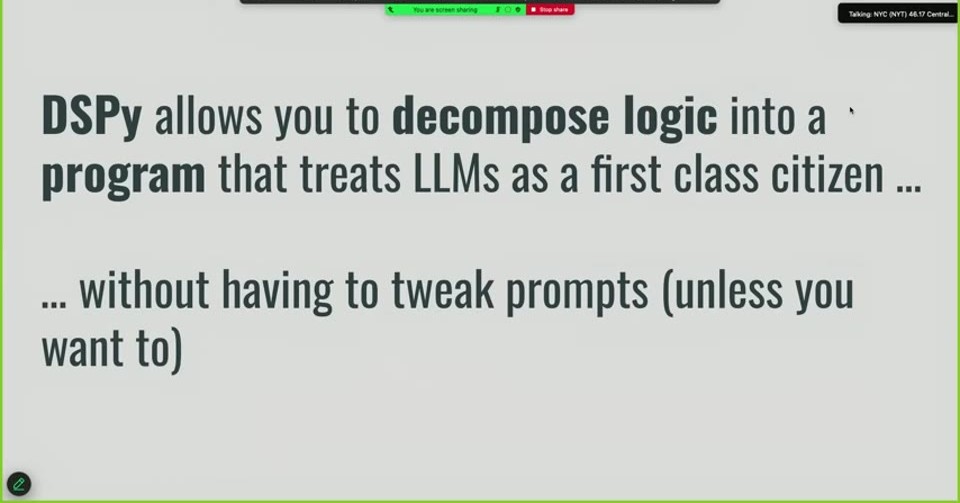
youtube--cKUW6n8hBU - Slide deck: Dense Slides: DSPy: The End of Prompt Engineering - Kevin Madura, AlixPartners — 12 visible slide image(s); 12 HTML recreation(s).
- Additional slide evidence: Slides: DSPy: The End of Prompt Engineering - Kevin Madura, AlixPartners, Reconstructed Slides: DSPy: The End of Prompt Engineering - Kevin Madura, AlixPartners
- Slide-derived themes for
youtube--cKUW6n8hBU: document, declarative, framework, modular, software, cases, lighting, round.
Evidence Graph
This evidence graph is generated from currently linked source material: official schedule text, related video pages, cached transcripts, visible slide text, dense/reconstructed slide pages, and AI slide-classification audits.
Media Signals
youtube--cKUW6n8hBU— 8 slide-derived text signals- Slide-derived themes for
youtube--cKUW6n8hBU: document, declarative, framework, modular, software, cases, lighting, round. - Evidence links for
youtube--cKUW6n8hBU: youtube cKUW6n8hBU, youtube cKUW6n8hBU slides, youtube cKUW6n8hBU dense slides, youtube cKUW6n8hBU reconstructed slides
Agent Reading Notes
Use these signals to refine the synopsis, topic links, people/company context, and method notes. If a source is a related external video rather than an exact official recording, keep it framed as supporting evidence.
Summary
Kevin Madura’s session frames Recursive Language Models as a practical abstraction for context-heavy AI work: instead of treating an LLM call as the final step in a prompt chain, an RLM can recursively invoke language-model behavior as part of a composable program. The linked speaker profile and related DSPy material point to an enterprise-focused perspective, with Madura drawing from work at AlixPartners on real-world AI systems, DSPy, RLMs, and agent-native architectures. The supporting slides from his prior AI Engineer talk, “DSPy: The End of Prompt Engineering,” suggest this session is likely to emphasize moving beyond hand-tuned prompts toward declarative, testable, reusable AI programs.
The scheduled description positions RLMs as different from coding agents: useful where prompt engineering, custom scaffolding, or multi-step orchestration would otherwise add complexity. The core comparison is expected to be concrete rather than theoretical, covering where recursive model calls simplify implementation, where they introduce trade-offs, and how they compare on complexity, performance, latency, and token usage. The related video and transcript map should be treated as supporting context only, not as confirmation of this exact World’s Fair session recording.
Transcript Status
Related video transcript availability: English auto-captions. Treat this as supporting context, not a recording of this exact scheduled session unless later confirmed. Not fetched yet.
People
Supporting Slides
- youtube cKUW6n8hBU slides — extracted from the related public AI Engineer video.
Slide Evidence
- Slide-only cropped deck: youtube cKUW6n8hBU dense slides (12 viable slide images).
- Related slide/OCR pages:
- youtube cKUW6n8hBU dense slides
- youtube cKUW6n8hBU reconstructed slides
- youtube cKUW6n8hBU slides
- Slide-derived terms:
dspy,shares,document,attachments,program,total,python,sold,structured,code,were,find,allows,class,transactions,applying,step,sentiment
Attendance Visibility
No high-confidence attendance icon signal is shown for this talk. The sampled video evidence was either low confidence, source-proxy-only, or did not expose a clear audience view.
Synthesis
Synthesized Breakdown
It’s Tokens All The Way Down: How RLMs are Different ## Conference Context - Date/time: 2026-06-30 · 11:10am-11:30am - Track/room: Context Engineering · Track 8 - Speaker(s): Kevin Madura - Session type/status: session · confirmed - Track: Context Engineering - Room: Track 8 - Session type: session - Status: confirmed ## Session Description Recursive Language Models represent an intuitive but distinctively important approach to how LLMs handle context. The practical implications are bigger than they first appear. Tasks that would traditionally require careful prompt engineering, custom agent scaffolding, or multi-step orchestration collapse into surprisingly simple, composable programs. In this talk, we’ll cover what makes an RLM distinct from a coding agent, explore where the abstraction shines and where it breaks down, and walk through concrete use cases that are informed by real-world situations at scale.
Speaker And Company Context
- No speaker profile is attached in the official schedule data.
Topics Covered
Derived Links And Source Material
- youtube cKUW6n8hBU — related YouTube source page.
- youtube cKUW6n8hBU slides — slide evidence.
- youtube cKUW6n8hBU reconstructed slides — slide evidence.
- youtube cKUW6n8hBU dense slides — slide evidence.
Novel Concepts / Clever Methods
- No highlighted novel concept has been detected yet.
Evidence Boundary
This synthesis is based on the official schedule and linked source pages. It should be revisited when exact session recordings or transcript-backed secondary sources are available.