An AI Future Without the Lock-In
Conference Context
- Date/time: 2026-07-01 · 3:20pm-3:40pm
- Track/room: track TBD · Expo Stage 4 SE
- Speaker(s): Remy Guercio
- Session type/status: session · confirmed
- Track: track TBD
- Room: Expo Stage 4 SE
- Session type: session
- Status: confirmed
Session Description
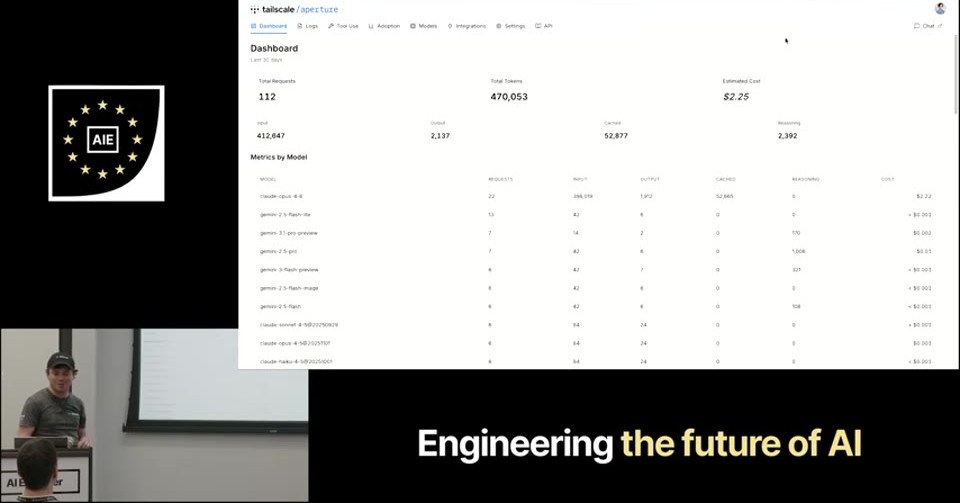
Every organization navigating AI adoption faces the same trap: the market moves faster than any procurement cycle, no single vendor leads across model quality, interface, sandbox, and data access for more than a few months at a time, and the obvious answer of consolidating behind one platform trades short-term control for long-term lock-in. This session makes the case that the winning strategy is not picking the best walled garden. It is building a connective layer underneath all of them. Tailscale's Remy Guercio walks through the four components required for transformative AI, why vertically integrated stacks are structurally fragile, and how organizations can maintain visibility and control without betting on a single vendor's continued dominance. The second half of the session covers three new capabilities in Aperture, Tailscale's identity-aware AI gateway: Identity-Aware Universal Data Connectors (Public Alpha), which translate Tailscale network identity into scoped access to internal data sources via MCP and API endpoints; a Responsive Chat UI (Public Alpha) that gives non-technical users a mobile-friendly interface to every LLM configured in Aperture; and Sandbox Support (Private Alpha), bringing ephemeral and persistent compute environments into the same identity model. Attendees leave with a framework for evaluating AI platforms that does not depend on picking a winner, and a concrete path to deploying provider-agnostic AI tooling on infrastructure they already run.
Media Evidence
What if the network was the sandbox? — Remy Guercio, Tailscale (speaker-match related prior/adjacent AI Engineer video; captions: English auto-captions).
- Source video:
youtube-BM2JX9hqsVQ - Slide deck: Dense Slides: What if the network was the sandbox? — Remy Guercio, Tailscale — 1 visible slide image(s); 1 HTML recreation(s).
- Additional slide evidence: Slides: What if the network was the sandbox? — Remy Guercio, Tailscale, Reconstructed Slides: What if the network was the sandbox? — Remy Guercio, Tailscale
- Slide-derived themes for
youtube-BM2JX9hqsVQ: engineering, future.
Evidence Graph
This evidence graph is generated from currently linked source material: official schedule text, related video pages, cached transcripts, visible slide text, dense/reconstructed slide pages, and AI slide-classification audits.
Media Signals
youtube-BM2JX9hqsVQ— 1 slide-derived text signals- Slide-derived themes for
youtube-BM2JX9hqsVQ: engineering, future. - Evidence links for
youtube-BM2JX9hqsVQ: youtube BM2JX9hqsVQ, youtube BM2JX9hqsVQ slides, youtube BM2JX9hqsVQ dense slides, youtube BM2JX9hqsVQ reconstructed slides
Agent Reading Notes
Use these signals to refine the synopsis, topic links, people/company context, and method notes. If a source is a related external video rather than an exact official recording, keep it framed as supporting evidence.
Transcript Status
Related video transcript availability: English auto-captions. Treat this as supporting context, not a recording of this exact scheduled session unless later confirmed. Not fetched yet.
People
Supporting Slides
- youtube BM2JX9hqsVQ slides — extracted from the related public AI Engineer video.
Slide Evidence
- Slide-only cropped deck: youtube BM2JX9hqsVQ dense slides (1 viable slide images).
- Related slide/OCR pages:
- youtube BM2JX9hqsVQ dense slides
- youtube BM2JX9hqsVQ reconstructed slides
- youtube BM2JX9hqsVQ slides
- Slide-derived terms:
tailscale,alengineer,engineering,future,braintrust,workos,openal,network,sandbox,components,europe,google,deepmind,sanc,aiengir,keys,pein,taliscale
Attendance Visibility
No high-confidence attendance icon signal is shown for this talk. The sampled video evidence was either low confidence, source-proxy-only, or did not expose a clear audience view.
Synthesis
Synthesized Breakdown
An AI Future Without the Lock-In ## Conference Context - Date/time: 2026-07-01 · 3:20pm-3:40pm - Track/room: track TBD · Expo Stage 4 SE - Speaker(s): Remy Guercio - Session type/status: session · confirmed - Track: track TBD - Room: Expo Stage 4 SE - Session type: session - Status: confirmed ## Session Description Every organization navigating AI adoption faces the same trap: the market moves faster than any procurement cycle, no single vendor leads across model quality, interface, sandbox, and data access for more than a few months at a time, and the obvious answer of consolidating behind one platform trades short-term control for long-term lock-in. This session makes the case that the winning strategy is not picking the best walled garden. It is building a connective layer underneath all of them. Tailscale's Remy Guercio walks through the four components required for transformative AI, why vertically integrated stacks are structurally fragile, and how organizations can maintain visibility and control without betting on a single vendor's continued dominance.
Speaker And Company Context
- Remy Guercio — Strategic Projects at Tailscale.
Topics Covered
Derived Links And Source Material
- youtube BM2JX9hqsVQ — related YouTube source page.
- youtube BM2JX9hqsVQ slides — slide evidence.
- youtube BM2JX9hqsVQ reconstructed slides — slide evidence.
- youtube BM2JX9hqsVQ dense slides — slide evidence.
Novel Concepts / Clever Methods
- No highlighted novel concept has been detected yet.
Evidence Boundary
This synthesis is based on the official schedule and linked source pages. It should be revisited when exact session recordings or transcript-backed secondary sources are available.