200 Million Patient Interactions Later: What the Generic Voice Stack Misses
Conference Context
- Date/time: 2026-07-01 · 12:05pm-12:25pm
- Track/room: AI in Healthcare · Track 7
- Speaker(s): Vivek Muppalla
- Session type/status: session · confirmed
- Track: AI in Healthcare
- Room: Track 7
- Session type: session
- Status: confirmed
Session Description
A healthcare voice agent can be right on the benchmark and still fail in production. Real patients hesitate, interrupt, misremember medications, code-switch mid-sentence, and disclose risk indirectly. After 200M+ patient-agent interactions, the lesson is clear: in clinical voice AI, interaction is a safety variable. This talk breaks down what Hippocratic AI had to rebuild beyond the generic voice stack: not just ASR, VAD, an LLM, TTS, and turn-taking heuristics, but a real-time safety system that treats silence, clarification, escalation, multilingual continuity, and medication-specific recognition as first-class engineering problems. We’ll walk through the production architecture behind Hippocratic AI’s voice agents: a 30+ model supervisor constellation, including the 4.1T-parameter AI Front Door system, designed to catch failures a single primary model misses. The talk covers how specialized models monitor medication identification, overdose risk, labs and vitals, escalation criteria, workflow confirmation, and other clinical safety surfaces while the patient conversation is still happening. We’ll focus on four production lessons: - Benchmarks are not enough: MedQA and USMLE-style accuracy do not capture the failure modes that appear in a 12-minute, multi-turn patient call. - Interaction signals become training data: pauses, interruptions, hesitation, clarification requests, and escalation markers are mined from production calls and turned into structured eval and training signals. - One LLM is not a safety architecture: supervisor models can overrule, block, or escalate when the primary model sounds plausible but misses a clinical risk. - Voice infrastructure has clinical failure modes: domain ASR, medication vocabulary, code-switching, latency, and turn-taking all affect whether the system makes the right next move.
Media Evidence
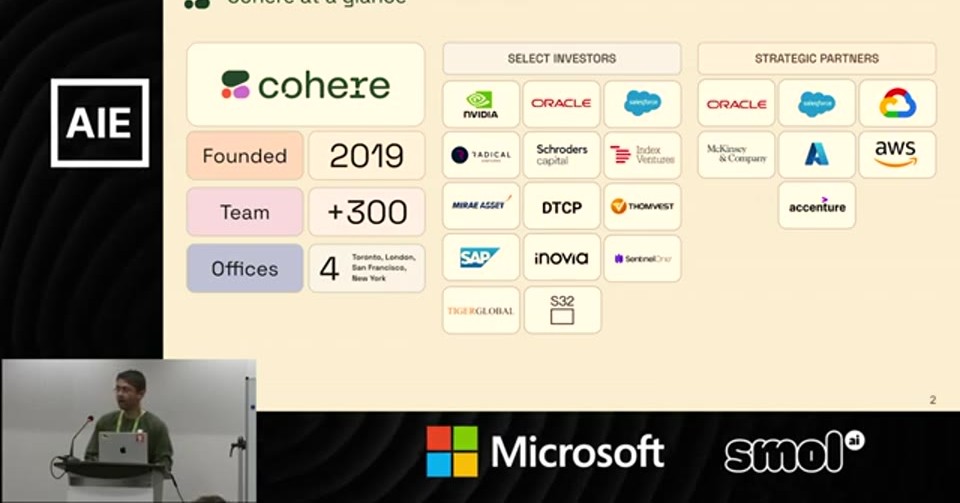
Cohere for VPs of AI: Vivek Muppalla (speaker-match related prior/adjacent AI Engineer video; captions: English auto-captions).
- Source video:
youtube-u3NofYYstaY - Slide deck: Dense Slides: Cohere for VPs of AI: Vivek Muppalla — 1 visible slide image(s); 1 HTML recreation(s).
- Additional slide evidence: Slides: Cohere for VPs of AI: Vivek Muppalla, Reconstructed Slides: Cohere for VPs of AI: Vivek Muppalla
- Slide-derived themes for
youtube-u3NofYYstaY: oracle, team, accenture.
Evidence Graph
This evidence graph is generated from currently linked source material: official schedule text, related video pages, cached transcripts, visible slide text, dense/reconstructed slide pages, and AI slide-classification audits.
Media Signals
youtube-u3NofYYstaY— 2 slide-derived text signals- Slide-derived themes for
youtube-u3NofYYstaY: oracle, team, accenture. - Evidence links for
youtube-u3NofYYstaY: youtube u3NofYYstaY, youtube u3NofYYstaY slides, youtube u3NofYYstaY dense slides, youtube u3NofYYstaY reconstructed slides
Agent Reading Notes
Use these signals to refine the synopsis, topic links, people/company context, and method notes. If a source is a related external video rather than an exact official recording, keep it framed as supporting evidence.
Transcript Status
Related video transcript availability: English auto-captions. Treat this as supporting context, not a recording of this exact scheduled session unless later confirmed. Not fetched yet.
People
Supporting Slides
- youtube u3NofYYstaY slides — extracted from the related public AI Engineer video.
Slide Evidence
- Slide-only cropped deck: youtube u3NofYYstaY dense slides (1 viable slide images).
- Related slide/OCR pages:
- youtube u3NofYYstaY dense slides
- youtube u3NofYYstaY reconstructed slides
- youtube u3NofYYstaY slides
- Slide-derived terms:
cohere,text,multilingual,enterprise,awws,mongodb,cloud,neoy,glance,select,investors,strategic,partners,bcohere,gomes,founded,team,otcr
Attendance Visibility
No high-confidence attendance icon signal is shown for this talk. The sampled video evidence was either low confidence, source-proxy-only, or did not expose a clear audience view.
Synthesis
Synthesized Breakdown
200 Million Patient Interactions Later: What the Generic Voice Stack Misses ## Conference Context - Date/time: 2026-07-01 · 12:05pm-12:25pm - Track/room: AI in Healthcare · Track 7 - Speaker(s): Vivek Muppalla - Session type/status: session · confirmed - Track: AI in Healthcare - Room: Track 7 - Session type: session - Status: confirmed ## Session Description A healthcare voice agent can be right on the benchmark and still fail in production. Real patients hesitate, interrupt, misremember medications, code-switch mid-sentence, and disclose risk indirectly. After 200M+ patient-agent interactions, the lesson is clear: in clinical voice AI, interaction is a safety variable. This talk breaks down what Hippocratic AI had to rebuild beyond the generic voice stack: not just ASR, VAD, an LLM, TTS, and turn-taking heuristics, but a real-time safety system that treats silence, clarification, escalation, multilingual continuity, and medication-specific recognition as first-class engineering problems.
Speaker And Company Context
- Vivek Muppalla — VP AI Engineering at Hippocratic AI.
Topics Covered
Derived Links And Source Material
- youtube u3NofYYstaY — related YouTube source page.
- youtube u3NofYYstaY slides — slide evidence.
- youtube u3NofYYstaY reconstructed slides — slide evidence.
- youtube u3NofYYstaY dense slides — slide evidence.
Novel Concepts / Clever Methods
- No highlighted novel concept has been detected yet.
Evidence Boundary
This synthesis is based on the official schedule and linked source pages. It should be revisited when exact session recordings or transcript-backed secondary sources are available.